
Your Team Wears Your Brand Too
How to Create a
Brand-Aligned Wardrobe Strategy
for Employees

You spent time defining your brand.
You invested in the logo.
You chose the colors.
You built the website.
You refined the messaging.
You thought about your office, signage, packaging, marketing materials, social media, and customer experience.
When YOU walk into a meeting, networking event, or client appointment,
YOU look like your brand.
But, does your team?
For many business owners, this is where brand consistency begins to break down.
The owner shows up polished, intentional, and completely aligned with the business she has worked so hard to build. Meanwhile, members of the team may be showing up with completely different interpretations of what is appropriate.
One employee looks corporate…another looks extremely casual…another looks like she could be representing an entirely different company.
Someone else is wearing the company logo, but the rest of the outfit doesn't necessarily support the image the company wants to project.
Individually, there may be absolutely nothing wrong with what anyone is wearing.
COLLECTIVELY, however, they may not look like one brand.
THAT’s an important distinction.
This isn't simply a conversation about clothes. It's a conversation about brand perception, consistency, leadership, and the customer experience.
If your employees represent your company, they don't just work for the brand.
They wear it, too.
Your Employees Are Brand Touchpoints
We often think of brand touchpoints as things such as:
Your website
Your logo
Your social media
Your storefront
Your packaging
Your signage
Your emails
Your marketing materials
A brand touchpoint is really any interaction someone has with your business that influences their perception of it.
That means
your employees are some of your most important brand touchpoints.
Think about how many situations
involve someone other than the owner representing the business.
Your employee may:
Greet customers at the front desk
Walk into a client's home
Attend a networking event
Staff a trade-show booth
Make a delivery
Lead a meeting
Attend a community event
Speak on behalf of the organization
Appear in social media content
Participate in a video
Represent the company at a fundraiser
Meet with vendors or referral partners
In each of those moments, that employee is contributing to someone's perception of your brand.
Before they say very much at all, they're already communicating something visually.
The question is:
Does that visual message support the brand experience you're trying to create?
Start With the Brand…Not the Clothes
Before talking about polos, pants, shoes, blazers, or uniforms,
start somewhere much more important:
How do you want your brand to be perceived?
Complete this sentence:
“When someone interacts with a member of our team, we want them to perceive us as…”
Choose 3-5 words.
Maybe your words are:
Professional
Approachable
Modern
Polished
Friendly
Sophisticated
Energetic
Creative
Trustworthy
Elevated
Warm
Capable
Innovative
Established
Those words become your filter.
Now, you can begin asking:
What does “approachable + professional” look like for our company?
OR
What does “modern + sophisticated + creative” look like?
OR
What does “friendly + trustworthy + polished” look like?
This is much more useful than simply telling employees:
“Please dress professionally.”
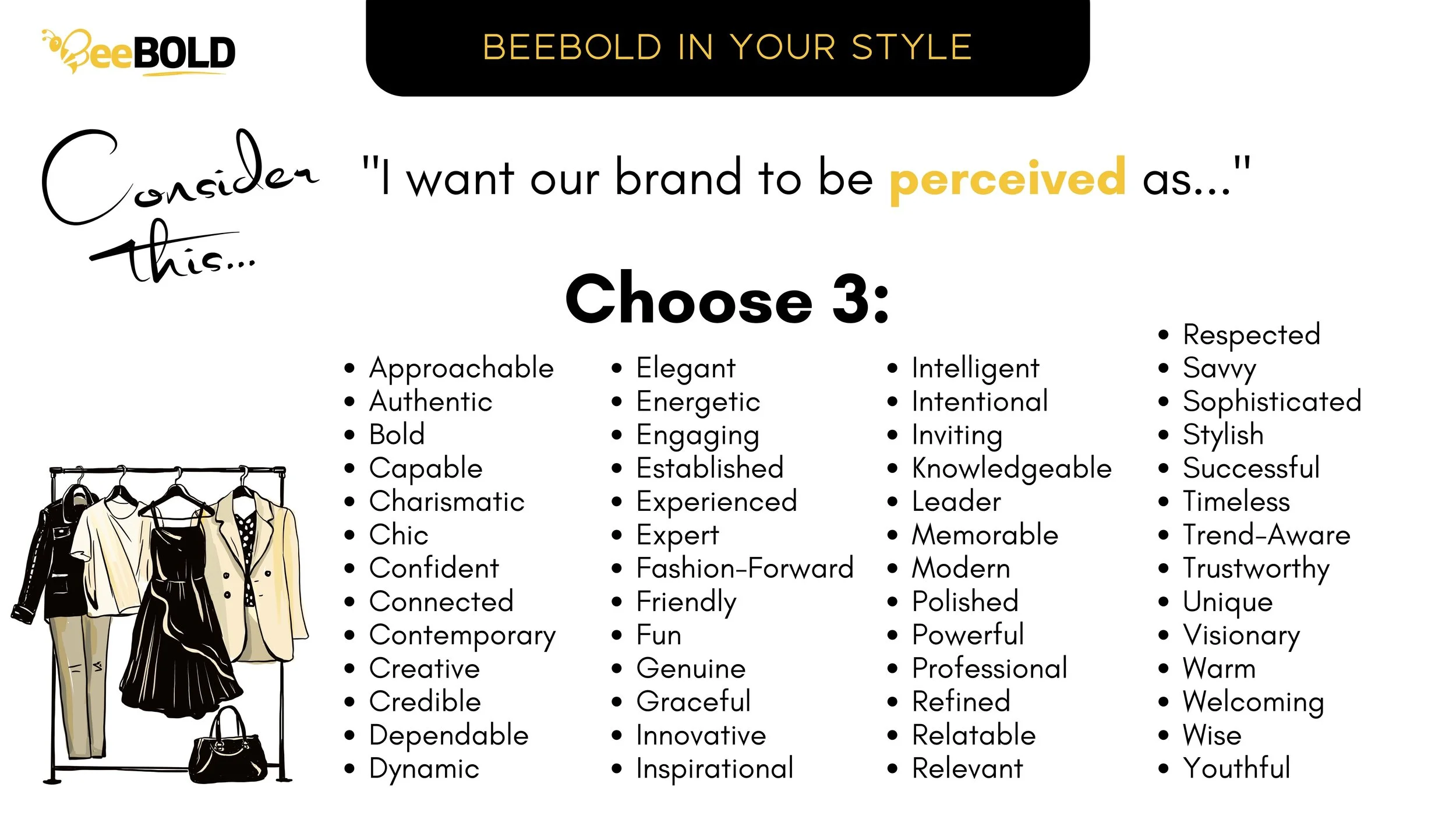
Image: Property of Kelly Buckner | BeeBold
There is no universally correct answer.
A children's nonprofit executive may want to communicate warmth, energy, professionalism, and approachability.
A luxury real estate professional may prioritize polished, sophisticated, established, and elevated.
A creative director might choose innovative, contemporary, interesting, and bold.
A financial professional might prioritize trustworthy, knowledgeable, credible, and polished.
Two women with the exact same profession may choose completely different words, because their brands, personalities, audiences, and positioning are different.
That's the point.
Your wardrobe should support YOUR brand…not someone else's version of what a successful woman is supposed to look like.
Once you choose your words, ask yourself:
If someone met me today without knowing anything about me,
would the way I'm dressed lead them to use some of these same words?
That question can reveal a lot.
The Problem With “Business Casual”
“Business casual,” “professional,” “appropriate,” “polished,” “nice,” “presentable”….
We've all heard these words in workplace dress expectations.
The problem? They're subjective.
Tell 10 people to dress “business casual,” and you may get 10 completely different outfits.
One person thinks business casual means “a blazer and trousers.”
Someone else thinks it means “jeans and a blouse.”
Another thinks “leggings and a long sweater” qualify.
Someone else arrives in a “polo and khakis.”
The business owner is left wondering: Why aren't they getting it?
They may not be getting it, because THE EXPECTATION WAS NEVER SPECIFIC ENOUGH to begin with.
Your employees shouldn't have to decode your definition of “professional.”
Show them…literally VISUALLY.
Create a Brand Wardrobe Framework
Instead of relying solely on a traditional dress code, consider developing what I call a:
Brand Wardrobe Framework
A “dress code” primarily tells employees what they can and cannot wear.
A Brand Wardrobe Framework goes further.
It helps employees understand:
WHO we are.
HOW we want to be perceived.
WHAT that looks like.
WHY it matters.
Then, it gives them enough structure to make good wardrobe decisions ON THEIR OWN.
Think of it as:
Freedom Within a Framework.
YOU establish the boundaries.
Your employees retain some INDIVIDUALITY within them.
Think Like a ‘Parent’: Curate the Choices
Here's a simple way to think about creating wardrobe options for your team: Imagine a parent helping a young child get dressed.
A parent may want the child to have some independence and personality.
They don't necessarily want to dictate, “You're wearing this exact outfit today.”
They also know that opening the closet doors and saying, “Wear absolutely anything you want!” could produce some interesting results!
Instead, the parent might pull out 3, 4, or 5 outfits that are appropriate for the day, the weather, and wherever they're going.
Then they say: “Which one would you like to wear?”
The child gets to choose., but here's the important part:
The parent is happy with every available choice.
That's a great model for thinking about your team's wardrobe.
As the business owner, you establish the curated choices. Perhaps you've created 3 to 5 approved outfit formulas, several company-provided pieces, a defined color palette, or a visual guide showing combinations that represent the brand well.
Then, your employee gets to decide:
“Which version of our brand feels most like me today?”
You're not asking every employee to dress identically, and you're not removing their ability to express themselves.
You're simply narrowing the entire “closet” down to a collection of options that you already know will represent the business well.
Freedom Within a Framework
You define the framework. They make the choice.
That balance can be incredibly effective for a team, because it gives employees autonomy without asking them to interpret vague instructions such as “dress professionally” or “look on-brand.”
There's another benefit:
you're shifting the conversation away from correction and toward choice.
Instead of constantly telling employees what not to wear, you're showing them several things they CAN wear.
That's a much more positive approach to creating brand consistency.
Think of it this way:
Don't give your team the entire closet, and “hope” they choose what you had in mind.
Curate the closet, and then let them choose.
When every available option supports the brand,
employees get individuality and the business gets consistency.
That's the SWEET SPOT.
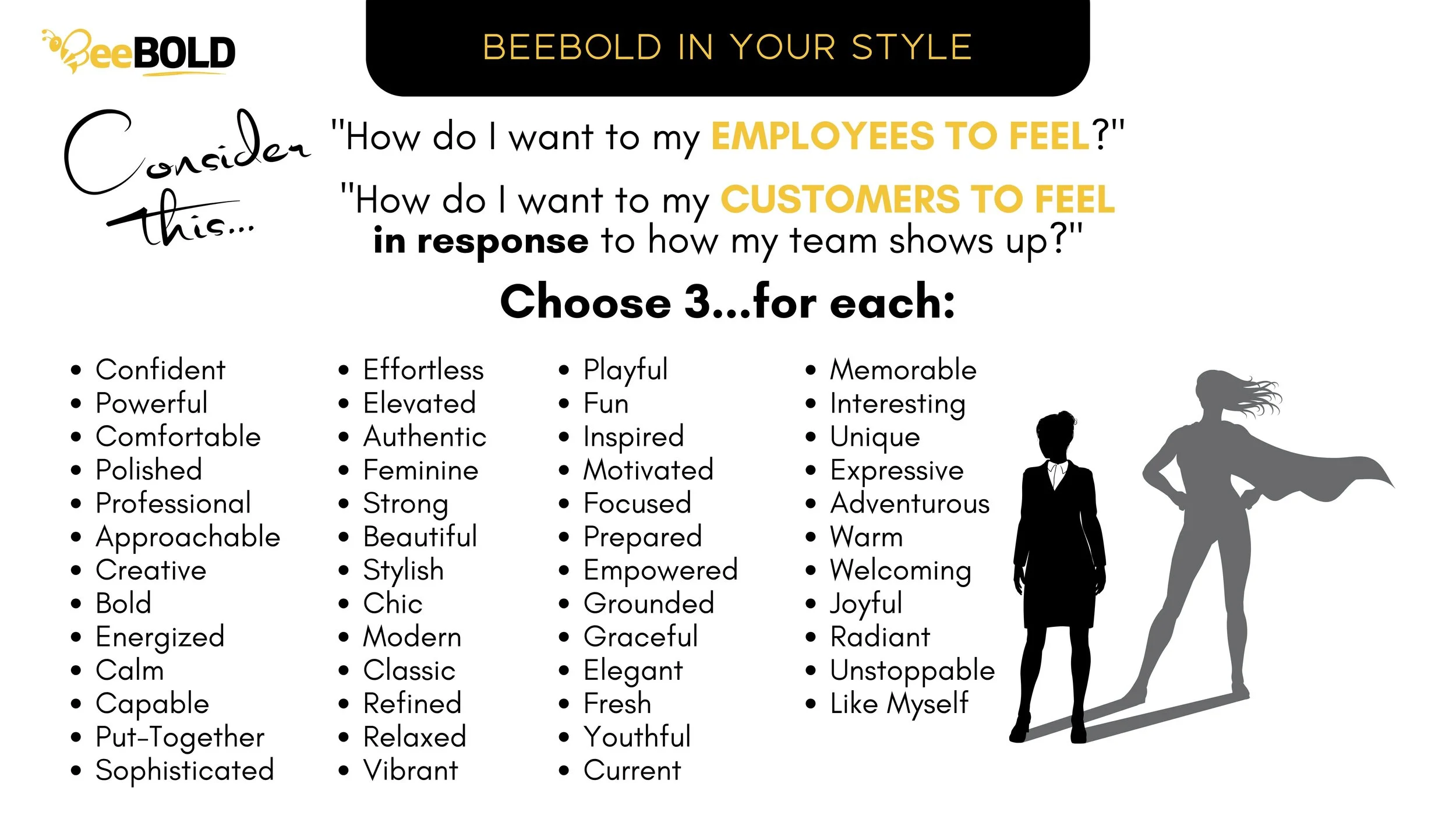
Image: Property of Kelly Buckner | BeeBold
What Should Be Included in a Brand Wardrobe Framework?
Keep it simple!
Here are several components to consider:
Your Brand Perception Words
Begin with those 3-5 words describing how customers should perceive your team.
For example:
Polished + Approachable + Modern + Confident
Put these words directly into your employee style guide.
These words provide context for everything that follows.
Your Everyday Brand Look
What does a normal workday look like? BE SPECIFIC.
For example:
Everyday Brand Look
Branded polo, button-down, or approved solid top
Tailored pants or dark, non-distressed denim
Clean professional shoes
Simple accessories
Branded outerwear, when needed
Already, you've provided significantly more clarity than: “Business casual required.”
Your Client-Facing Look
Maybe employees need to elevate their appearance when they're interacting directly with clients. DEFINE THAT.
For example:
Client-Facing Brand Look
Blouse, button-down, polo, or branded top
Blazer or structured layer when appropriate
Tailored pants, skirt, or dark denim depending on your industry
Polished shoes
Name badge or branded accessory
Employees now understand that different situations may require different levels of presentation.
Your Event Look
What should employees wear when representing the company publicly?
Think:
Conferences
Networking events
Trade shows
Community events
Fundraisers
Speaking engagements
Company photos
Video shoots
Don't wait until the morning of the event to figure this out.
Create an established formula.
EVENT LOOK
Branded jacket + approved top + black pants + coordinated shoes + name badge
Or whatever makes sense for your organization.
Now the team arrives looking intentional and cohesive.
UNIFYING ELEMENT
A simple unifying element (such as a signature branded shirt color) can create visual cohesion across your team without requiring everyone to dress alike…allowing individual style to shine while still making the group feel unmistakably connected to the same brand.
Consider Multiple Uniform Concepts
The word “uniform” sometimes makes people imagine every employee wearing exactly the same shirt and pants every day. It doesn't have to mean that.
A modern uniform strategy can provide several approved looks.
For example:
LOOK 1: Everyday
Branded polo + dark denim + clean sneakers or loafers
LOOK 2: Client Meeting
Button-down or blouse + tailored pants + professional shoes
LOOK 3: Event
Branded jacket + solid top + black pants + coordinated shoes
LOOK 4: Casual Community Day
Branded T-shirt + jeans + clean white sneakers
Now employees aren't wearing the exact same outfit every day,
but they're still clearly representing the same organization.

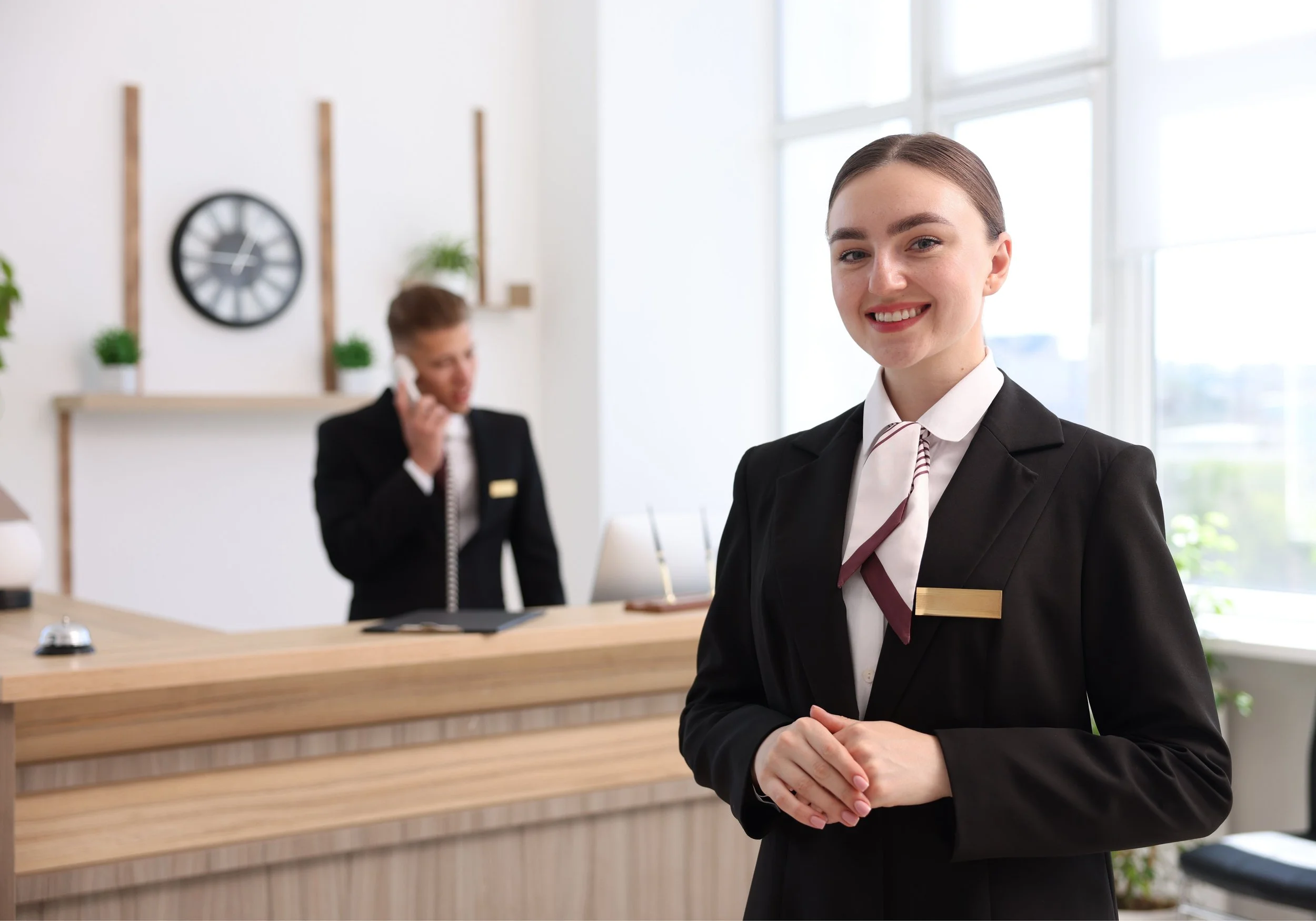


Sometimes, the Simplest Answer Is: Provide the Clothes
If you want employees to wear something very specific,
one of the easiest ways to achieve consistency is to provide it.
Depending on your business, that might include:
Polos
Button-down shirts
Blouses
T-shirts
Jackets
Vests
Aprons
Scrubs
Hats
Name badges
Outerwear
Then, establish simple guidelines for the remaining pieces.
For example:
WE PROVIDE:
Two branded polos and one branded jacket.
YOU PROVIDE:
Black or navy pants and clean black shoes.
However, you should still provide photos of example pant styles, and accessible shoe styles you expect. That removes a tremendous amount of ambiguity.
It can also reduce the financial burden on employees when you're asking them to meet a very specific visual standard.
Depending on the business and budget, you might also consider:
A wardrobe allowance
Seasonal clothing stipends
Preferred vendors
Employee discounts
Company ordering days
If you want consistency, give people the tools to achieve it.
Use Pictures, Not Just Words
This may be one of the most useful things you can do.
Create a SIMPLE VISUAL STYLE GUIDE.
Show employees examples of:
THIS FEELS LIKE OUR BRAND
Include examples of:
Tops
Pants
Dresses
Jackets
Shoes
Accessories
Colors
Layers
Complete outfits
You can even create a simple Pinterest-style mood board or Canva page with examples.
Visual examples are especially valuable, because employees don't have to interpret what you mean.
They can see it.
You might also include a section showing clothing that doesn't fit the work environment, but keep the focus on specific garments and standards rather than people's bodies or attractiveness.
THE GOAL ISN’T: “This person looks bad.”
THE GOAL IS: “THIS CLOTHING choice doesn't fit this particular professional environment.”
That's a very different message.
REMEMBER » Fit + Fabric + Flair
Check out this POST for more details.
The same Fit + Fabric + Flair principles that apply to personal professional style can also help employees.
FIT
Does the clothing fit appropriately for the role and allow the employee to perform the job comfortably and safely?
Are garments excessively oversized, too restrictive, or otherwise impractical for the work being performed?
FABRIC
Does the material SUPPORT THE BRAND & JOB?
Is it durable enough?
Does it wrinkle excessively?
Does it hold its shape?
Is it appropriate for Houston heat, outdoor work, food service, healthcare, office environments, or whatever conditions employees regularly encounter?
Think beyond appearance. Think about functionality.
FLAIR
Where can employees express their individuality…within reason?
Perhaps through:
Jewelry
Glasses
Shoes
Scarves
Hair accessories
Approved colors
Bags
Layering pieces
Your team doesn't necessarily need to become a row of identical mannequins…unless that is what you need or want for your brand.
Possibly consider:
Allowing some personality can actually make your brand feel more human, but ultimately that decision is up to you as the owner/leadership.
The goal is: Consistency without sameness.
A simple way to remember it:
Fit creates POLISH.
Fabric influences PERCEPTION.
Flair communicates PERSONALITY.
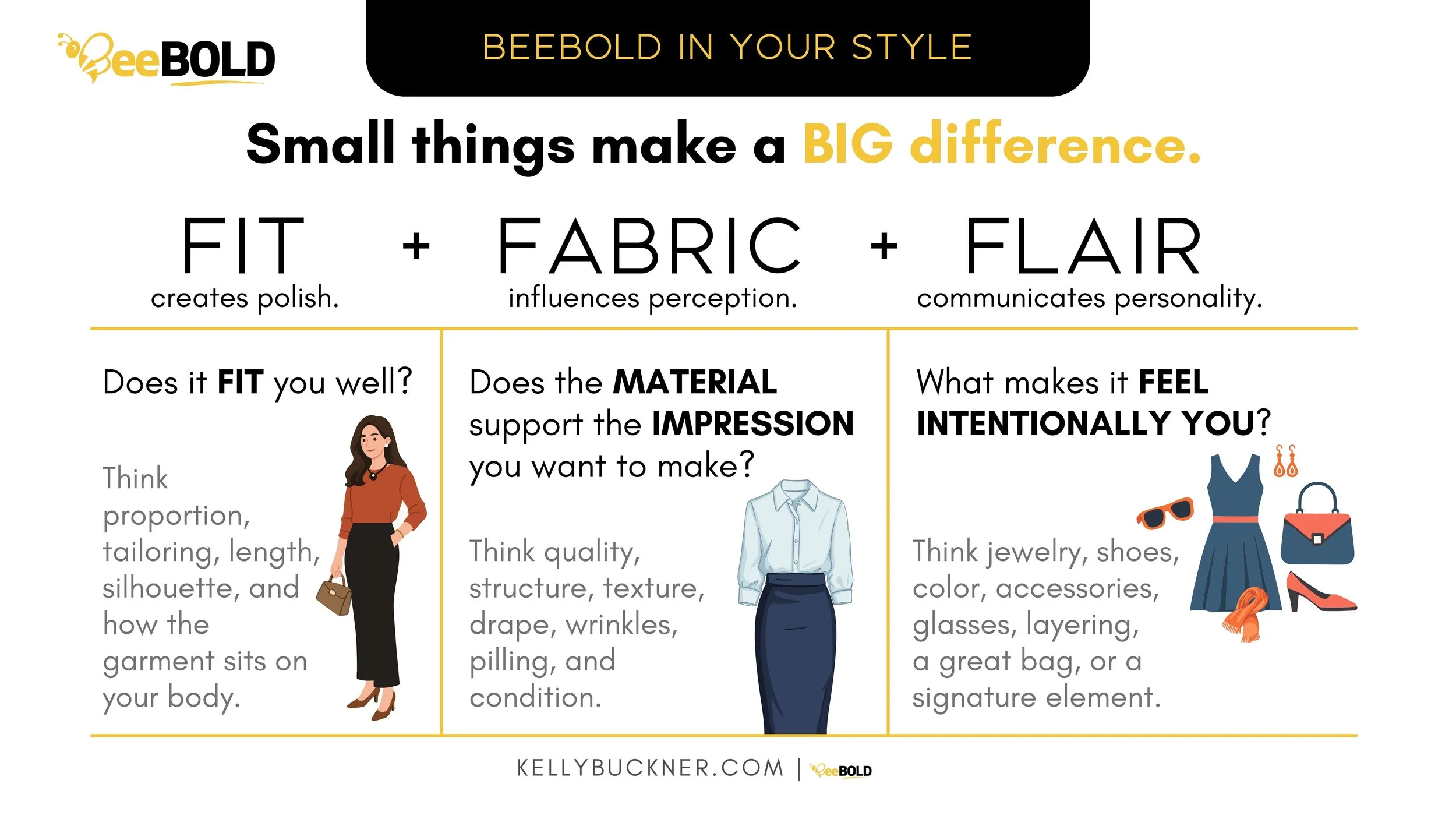
Image: Property of Kelly Buckner | BeeBold
Don't Forget » Different Bodies, Ages, and Needs
This deserves intentional consideration.
Your team may include people of different:
Heights
Body types
Ages
Mobility needs
Comfort requirements
Cultural backgrounds
Religious practices
One silhouette may not work equally well for everyone.
If you're providing uniforms or approved wardrobe pieces, consider offering several options.
Perhaps employees can choose between:
Polo OR button-down OR blouse
Straight-leg pants OR another approved silhouette
Jacket OR cardigan
You can create visual consistency through color, branding, fabric, and level of formality without forcing every person into exactly the same garment.
Your goal is to create a cohesive team…not erase individuality.
Think About the Entire Look
Sometimes, businesses invest in beautiful branded shirts,
yet forget about everything employees wear with them.
The shirt is only one piece of the visual presentation.
Consider establishing guidance around:
Pants
Denim
Shoes
Outerwear
Hats
Name badges
Bags
Aprons
Jackets
Seasonal clothing
IMAGINE: a beautifully branded polo paired…with extremely distressed jeans and worn-out shoes.
The company “technically” provided a uniform, but the overall brand experience may still feel inconsistent.
Think about the entire look.
Make Brand Presentation Part of Onboarding
One of the biggest mistakes business owners make
is waiting until there's a problem to discuss appearance.
That's when the conversation becomes uncomfortable.
Instead, discuss brand presentation before the employee ever begins representing the company.
Include your Brand Wardrobe Framework in onboarding.
Walk employees through:
Here's who we are.
Here's how we want customers to feel when they interact with us.
Here are our brand perception words.
Here's what that looks like when we're representing the company.
Here's what we provide.
Here's what you're responsible for providing.
Here are examples.
Here's who to ask if you're ever unsure.
Now, it isn't a personal conversation directed at one employee.
It's simply: How we ALL represent our brand.
Make It a Brand Conversation, Not a Personal Correction
If you're introducing a new wardrobe standard into an established business, resist the temptation to make the conversation about the one or two employees whose appearance prompted the change
Instead, bring the entire team into the conversation, and position it as the next evolution of the brand.
Explain that as the business has grown, you're becoming more intentional about creating a consistent experience at every customer touchpoint.
That includes: How the team represents the company visually
Introduce the new Brand Wardrobe Frameworkto everyone at the same time.
Explain the WHY behind it.
Show examples.
Provide clear options.
Invite questions.
This shifts the message from “You need to dress differently” to “This is how we are choosing to show up as a team.”
It also helps create a culture in which representing the brand is a shared responsibility rather than a rule aimed at one difficult employee.
When expectations become part of the culture, leaders can address future inconsistencies by referring back to an established team standard…not personal preference.
If an individual continues to disregard clearly communicated expectations, that can then be handled privately as a separate performance or policy conversation.
Explain WHY It MatTERS
People are much more likely to support a standard when they understand the reason behind it.
INSTEAD OF: “I need everyone to dress better.”
TRY: “Every person on our team contributes to the experience our customers have with our brand. We want the way we present ourselves to feel as thoughtful and consistent as the service we provide.”
Now, you've connected clothing to something bigger.
Customer trust
Professionalism
Brand consistency
Team pride
Business growth
The conversation becomes less about “fashion,
and more about shared responsibility for the brand experience.
Invite Your Team Into the Conversation
This process does not necessarily have to be a completely “top-down” in nature.
Try bringing your team into a brand discussion.
Give them your 3-5 brand perception words.
Then ask: “If these are the words we want customers to use to describe us, what should that look like?”
You might ask:
What feels appropriate?
What feels outdated?
What would make getting dressed easier?
What pieces would employees actually wear?
What works for the physical demands of the job?
What seasonal options are needed?
Where should employees have flexibility?
What could the company provide?
Your employees may identify practical issues you haven't considered.
When employees have some involvement in creating the framework, you may get much stronger buy-in.
What If Someone Still Doesn't Follow the Standard?
This is where clarity becomes incredibly valuable.
If expectations were vague, correcting an employee can feel subjective.
If the organization has already-established specific standards, the conversation becomes much more straightforward.
Instead of: “I don't really like what you're wearing.”
You can say: “For client appointments, our Brand Wardrobe Framework calls for our branded top, tailored pants or approved dark denim, and closed-toe professional shoes. Let's make sure we're following that standard going forward.”
You're discussing the standard, NOT the person's attractiveness, body, or personal taste.
That's important.
Keep Dress Conversations Focused on the Role & BRAND STANDARD, Not the Body
Workplace appearance is an area where leaders should communicate thoughtfully.
Keep conversations centered around:
The employee's role
The work environment
Safety
Clothing requirements
Established company standards
Customer experience
Brand presentation
Avoid comments about someone's:
Weight
Body shape
Age
Attractiveness
Physical features
The conversation should be about what someone is wearing IN RELATION TO a clearly established workplace standard, not whether you personally think the employee looks good.
Any workplace dress or grooming policy should be reviewed for compliance with applicable employment laws and applied consistently, including legally required accommodations.
When in doubt, involve a qualified HR or employment-law professional.
Be Consistent…Especially at the Top
Here's another important piece:
Leadership has to model the standard.
You can't ask employees to follow a brand presentation standard that leadership routinely ignores.
If your team is expected to wear the brand intentionally, managers and owners should demonstrate what that looks like.
Culture is rarely built by what leaders put in a handbook.
It's built by what leaders consistently model.
Your Brand Wardrobe Framework Doesn't Have to Be Expensive
Small businesses [sometimes] assume creating a cohesive team appearance requires a huge uniform budget. It doesn't. Start small.
Perhaps you:
Choose two approved shirt colors.
Provide one branded polo.
Establish dark denim as the standard.
Specify clean, professional shoes.
Provide name badges.
Create one event outfit formula.
Make a one-page visual guide.
That's already significantly more intentional than: “Just dress business casual.”
You can evolve the system as the business grows.
Do a Brand Wardrobe Audit
The next time your team is together, don't immediately evaluate individual employees.
INSTEAD, step back and look at the group as a whole.
ASK YOURSELF: If I didn't know these people worked together, would I know they represented the same brand?
THEN, ASK: Does the way our team looks support the experience we promise our customers?
FINALLY: What one change would create the greatest improvement?
Maybe it's providing better branded shirts.
Maybe it's clarifying shoes.
Maybe it's creating an event uniform.
Maybe it's establishing several approved outfit formulas.
Maybe it's simply showing everyone examples.
You may not need an enormous overhaul. Sometimes, a little clarity creates a big difference.
The BeeBold Brand Wardrobe Framework
If you're ready to begin, use these 6 questions:
1. HOW SHOULD OUR BRAND FEEL?
Choose 3–5 perception words.
2. WHAT IS OUR EVERYDAY LOOK?
Define the normal standard.
3. WHAT IS OUR CLIENT-FACING LOOK?
Identify when employees need to elevate.
4. WHAT IS OUR EVENT LOOK?
Create a consistent formula for public representation.
5. WHAT DOES THE COMPANY PROVIDE?
Determine uniforms, branded pieces, allowances, or accessories.
6. WHERE IS THE FLEX ZONE?
Identify where employees can express their personality.
That final question matters, because a great Brand Wardrobe Framework shouldn't simply tell people:
“Here's what you can't do.”
It should communicate:
“Here's who we are. Here's how we show up. Here's how you can still be YOU within our brand.”
Your Team Doesn't Need to Dress Like You
This is an important distinction for business owners:
Your goal should NOT be to turn every employee into a miniature version of the founder.
YOUR personal style may be part of YOUR personal brand.
Your employees have personalities and styles of their own.
What they need is not your wardrobe. They need your BRAND STANDARD.
Give them the framework.
Give them examples.
Give them options.
Give them the tools.
Give them room for individuality.
And most importantly, give them the WHY.
When employees UNDERSTAND that their appearance contributes to customer perception, they're participating in the brand experience, rather than simply following a dress code.
Your Brand Is Bigger Than the Person Who Owns It
As entrepreneurs, we often BEGIN AS the brand.
We're the salesperson.
We're the customer service department.
We're the marketer.
We're the person attending networking events.
We're the person meeting every client.
Then, the business grows.
Suddenly, other people are carrying our name into the world.
That's an exciting milestone, but it also requires a shift in thinking.
You can no longer personally control every brand interaction.
You have to equip other people to deliver it.
That includes:
How they communicate.
How they serve.
How they solve problems.
How they interact with customers.
How they show up.
If you're impeccably representing your brand while struggling to get your employees on the same page, don't simply keep reminding them to “dress more professionally.”
Create a system.
Define the perception.
Show them the vision.
Give them choices.
Provide what you can.
Train them.
Model it.
Then, give them room to make the brand their own…within reason.
Your team doesn't just work for your brand.
Your team helps your customers EXPERIENCE it.
When your people, presentation, service, messaging, and visual identity
all begin telling the same story…
That's when a business starts to feel like a brand.
Ready to Create a Brand Wardrobe Framework for YOUR Team?
You know your brand.
You know how you want customers to experience it.
Translating that vision into clear, practical wardrobe guidelines for an entire team can be challenging.
BeeBold can help!
Book a personalized Brand Wardrobe Framework Session designed specifically around
YOUR brand, YOUR team, YOUR audience, and YOUR customer experience.
Together, we'll define how you want your team to be perceived and create a practical framework that may include brand perception words, unifying elements, outfit formulas, uniform concepts, visual examples, company-provided pieces, and areas where employees can express their individuality.
The goal isn't to make everyone look the same. It's to give your team freedom within a framework, so they have choices while every choice still represents your brand well.
Stop hoping everyone interprets “dress appropriately” the same way.
Give your team clarity, confidence, and a shared vision for how your brand shows up.
Let's build a Brand Wardrobe Framework that looks and feels like YOUR brand!
Click the “Book Your BeeBold Session” button below OR CLICK HERE.
Select Brand Strategy Session.
Choose the TOPIC “Brand Wardrobe Framework Session (for your TEAM)” when filling out the intake form when booking the session.
Bold FAQ’s
Should a small business have an employee dress code?
A dress code can be especially valuable when employees interact with customers or publicly represent the company. Clear standards help employees understand how their appearance contributes to a consistent brand and customer experience.
How do you introduce a dress code to existing employees?
Introduce the change to the entire team as an evolution of the company's brand standards rather than singling out individual employees. Explain why the change matters, provide clear visual examples, establish a timeline, and give employees an opportunity to ask questions.
Should a company provide employee uniforms?
When a business requires specific branded garments or a highly consistent appearance, providing some or all of those pieces can make compliance easier and reduce ambiguity. Businesses should also consider applicable laws and reimbursement requirements when developing uniform policies.
How can employees maintain individuality while following a dress code?
Create “freedom within a framework.” Establish several approved outfit formulas or uniform options and clearly identify areas where employees can make personal choices, such as accessories, approved colors, shoes, or layering pieces.
How does employee appearance affect a brand?
Employees who interact with customers are part of the brand experience. Their appearance can contribute to perceptions of professionalism, consistency, approachability, credibility, and attention to detail.
HR & Employment Disclaimer
The information in this article is intended for general educational and brand-strategy purposes only and should not be considered legal, human resources, or employment advice. Workplace dress codes, uniforms, grooming standards, and appearance policies may be subject to federal, state, and local employment laws, including requirements related to discrimination, religious practices, disabilities, medical needs, gender expression, accommodations, safety, and employee expenses. Before implementing or changing a workplace dress or uniform policy, consult with a qualified HR professional or employment attorney to ensure your guidelines are lawful, inclusive, consistently applied, and appropriate for your organization and location.
BeeBOLD NOW
“She is clothed with strength and dignity; she can laugh at the days to come.”
Proverbs 31-35
Don’t be afraid to lean fully into your unique gifts. They’re your launchpad. You were never meant to reach everyone. You were designed to resonate deeply with the right people, the ones who need exactly what you bring to the table. When you stop trying to be everything to everyone and start showing up as fully you, your work becomes more than a job, it becomes purpose. The more you align with your calling, the more compelling your message becomes. Trust that the opportunities meant for you will find you when you lead with what makes you different. That’s playing in your lane, and that’s where impact thrives. When you get really good at navigating your unique lane, you can gain momentum and go the distance to create pathways of transformation beyond what you ever imagined.
LET’S TALK!
BeeBold can help you sharpen your message, tighten your focus, and shine exactly where you’re meant to.


employee dress code | workplace dress code | employee dress code policy | company dress code | business casual dress code | employee uniform ideas | company uniform ideas | branded employee uniforms | professional dress code | team uniform ideas | employee appearance guidelines | workplace appearance | brand consistency | employee brand standards | professional appearance at work | company dress standards | dress code for small business | branded workwear | employee uniform policy | business dress code | team wardrobe | Brand Wardrobe Framework | brand-aligned wardrobe | brand wardrobe strategy | team brand wardrobe | brand-aligned employee uniforms | employee brand experience | visual brand consistency | freedom within a framework | How do I create a dress code for my employees? | How should employees dress to represent a company? | How do I get employees to dress more professionally? | How do I implement a new dress code for existing employees? | How do I talk to employees about professional appearance? | How do I introduce uniforms to an existing team? | How do I create a company uniform? | What should employees wear to represent a brand? | How do I create a professional dress code without being too restrictive? | How can employees express individuality while wearing a uniform? | How do I create consistent uniforms for my team? | What should a small business dress code include? | How do you address an employee who doesn't dress professionally? | Should small businesses provide uniforms for employees? | How can employee appearance affect a company's brand? | How do I create a visual dress code for employees? | What does business casual mean for employees?
